What 18 Years of Practice and Observation Taught Me About Why Teams Break Down
Most of my life I have paid close attention to the way food — or the absence of it — was shaping not just health outcomes, but decisions, relationships, and the capacity to lead. What I found changed the way I think about business entirely.
I did not set out to build a business around nourishment. I set out to understand something I had been watching my whole life - the way some people, some families, some teams sustained themselves through genuinely hard circumstances, and others didn't.
And the way that difference was rarely explained by intelligence, or work ethic, or even resources.
It was explained, more often than not, by what people were eating. And whether they had the skills and the habits to keep eating well when things got difficult.
Where it started
I grew up surrounded by Jamaican family and culture. Food was never a domestic chore in that world. It was how people communicated care, how communities held together, how knowledge moved between generations. You learned to cook because cooking was how you sustained yourself and the people around you - not as a lifestyle choice, but as a matter of course.
I absorbed that before I could articulate it. I spent the next 18 years trying to understand it properly - following the thread from the kitchen to the business, exploring the link between nutrition and business performance at every level.
What I found, documented across nearly two decades of research, practice, and lived experience, is that the thread is real. And it is almost entirely absent from how we talk about business performance.
What 18 years of practice and observation actually shows
The connection between nutritional status and cognitive performance is not a wellness claim. It is well-documented neuroscience. The prefrontal cortex - the part of the brain responsible for planning, decision-making, and emotional regulation - is acutely sensitive to blood glucose stability, micronutrient availability, and the hormonal environment created by chronic stress.
When the diet is consistently poor, not dramatically poor, but ordinarily poor in the way that skipped lunches, ultra-processed convenience food, and improvised snacking produce, that environment degrades. Not dramatically. Gradually. The quality of decisions gets slightly worse. The emotional reactivity under pressure gets slightly higher. The recovery time after difficult periods gets slightly longer.

None of this shows up on a performance review. All of it affects the business.
I have seen this pattern in entrepreneurs working alone, in founding teams building under pressure, in small business teams that have all the right ingredients - smart people, clear mission, strong leadership - and still find themselves wearing down faster than makes sense. The explanation is almost always the same when you look closely enough: the physiological foundation is not there.
The part that most business conversations skip
When I talk to business leaders about burnout, the conversation almost always focuses on three things: workload, management quality, and working hours. These are legitimate variables. But they address only the stress load - how much pressure the system is under. They say almost nothing about the system's capacity to handle that pressure.
That capacity is built physiologically. Through sleep, movement, and - most foundationally, most consistently, most overlooked - nourishment.
A team that is eating well, that has the skills to cook and the habits to nourish itself consistently, handles pressure differently. Not because they are more motivated or more disciplined. Because their stress regulation system has what it needs to function. Their cortisol response is better calibrated. Their cognitive performance holds up further into a difficult week. Their recovery is faster.
This is not a theory. It is biology. And it is the half of the burnout equation that almost every business strategy has never touched.
Why I built Empire Kitchen
My published research - Is It LEGIT? Redefining Equity, Leadership and Influence in Online Business - documents the specific connections between nutrition and business performance, leadership capacity, and what makes teams sustain over time. The finding that runs through all of it is simple: the teams and families that thrive are the ones that treat nourishment as a foundation, not an afterthought.
Empire Kitchen exists to make that foundation accessible to small business teams. Not as a wellness programme. Not as a cooking class. As a business strategy - evidence-based, practically delivered, immediately usable.
The reason it takes the form of a 90-minute workshop with a live cooking demonstration is deliberate. The cooking is not the product. It is the proof. When a team watches a complete, nourishing meal built from scratch in under an hour - on a Zoom call, in a real kitchen, alongside the evidence for why it matters - something shifts. The barrier between knowing and doing gets smaller. And that is where change actually begins.
What I want leaders to understand
You do not need to overhaul your team's lifestyle. You do not need to prescribe what people eat or moralize about food choices. You need to make the connection visible - to show your team, clearly and with evidence, that what they eat affects how they perform - and give them a practical framework simple enough to actually use.
That is a 90-minute investment. It is upstream of every other wellbeing intervention you have tried. And it is the one that makes all the others work better.
Eighteen years of practice and oberservation brought me here. And it keeps bringing me back to the same place: the kitchen is where it starts.
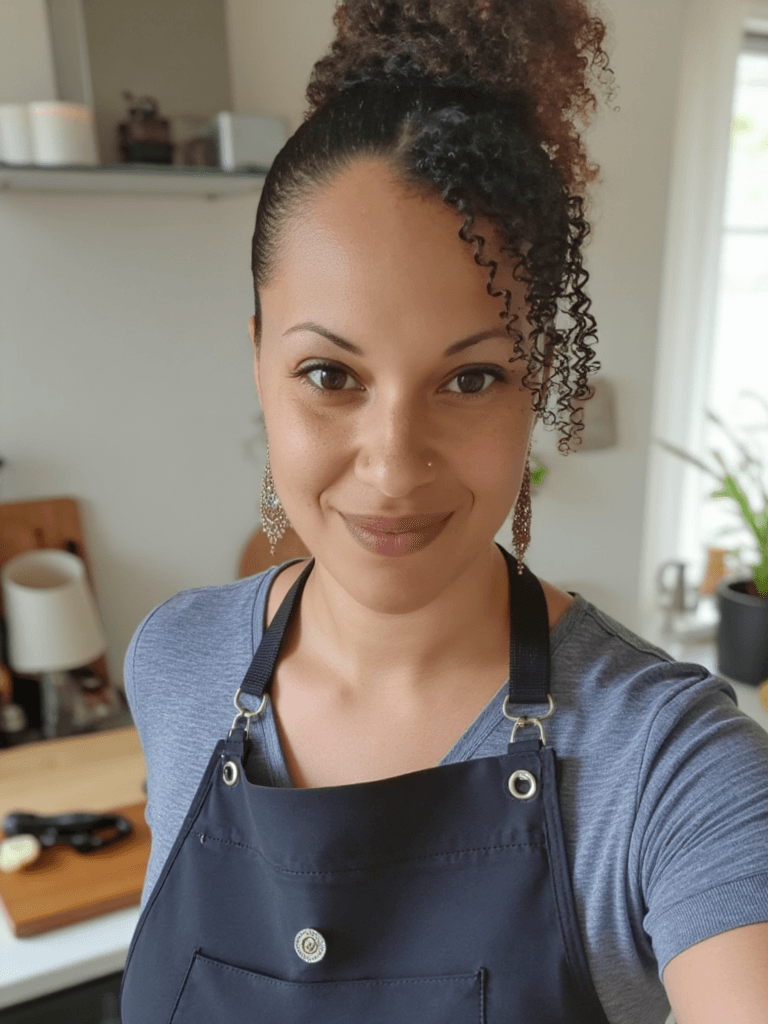
Lace Flowers is the founder of Empire Kitchen, Co-Founder of The Flavor Room and co-author of Redefining Equity, Leadership and Influence in Online Business. She works with small business teams to build nourishment into their culture as a business strategy — not an afterthought.
Food culture writer exploring the diaspora kitchen.
All rights reserved.
© 2026 Empire Kitchen