The Skill Being Lost Across Generations and Why Your Business Should Care
Every culture in human history has organised itself, in part, around food. Not just eating — cooking, sharing, gathering. That practice is not sentiment. It is how we have always regulated, connected, and sustained ourselves. And for the first time, it is genuinely at risk.
By Lace Flowers · Founder, Empire Kitchen
I want to tell you something I have been watching for a long time, from a specific vantage point.
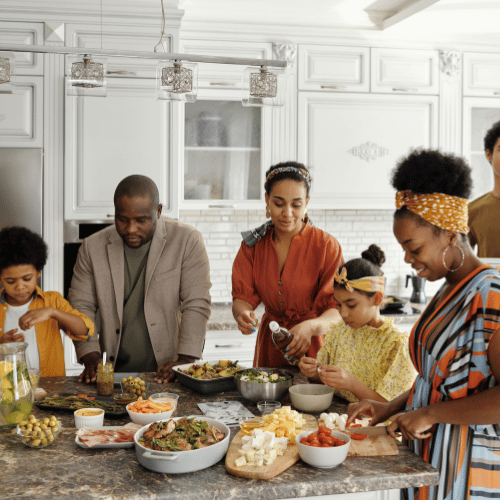
I grew up surrounded by Jamaican family and culture, in a household where the kitchen was the centre of everything. Meals were not scheduled around the day - the day was scheduled around meals. Cooking was not a chore to be optimised away. It was the place where knowledge passed between people. Where care was demonstrated. Where the community that sustained you was built and maintained, one meal at a time.
I did not understand the full significance of that until much later. Until I started studying, systematically, what happens when it is absent.
What the research says about shared meals
The evidence for the importance of cooking and communal eating is not soft. Research consistently shows that teams who eat together demonstrate higher levels of trust and psychological safety than those who do not. A Cornell University study found that firefighting crews who cooked and ate together performed measurably better on the job than those who ate separately. The act of preparing and sharing food is not incidental to team cohesion. It is one of its foundations.
This makes evolutionary sense. Humans have gathered around food for the entirety of recorded history and long before that. It is one of the most ancient and consistent mechanisms by which groups have built the trust necessary to function under pressure. The business world did not invent this. It inherited it. And it is slowly, inadvertently, dismantling it.
The generational break
Something significant has happened in the last two decades that has no real precedent in human history: cooking skills are being lost across generations, and for the first time, a generation has entered adulthood without the ability to feed itself from scratch.
Research and surveys consistently show that the majority of Gen Z adults cannot cook a basic meal. This is not a character failing. It is the output of a specific set of structural forces that converged on this generation simultaneously: dual-income households where time poverty reduced cooking at home, the removal of food education from school curriculums, the normalisation of ultra-processed food as a daily default, and the arrival of delivery culture that made cooking feel genuinely optional.

The result is a generation that cares deeply about food - more conscious of ingredients, ethics, and nutrition than any before it but that lacks the most basic skill to act on that awareness. They know what good nourishment looks like. They often do not know how to make it.
And here is the part that I find most important: if this generation does not rebuild the skill, the next generation will not learn it either. The chain of transmission that has carried this knowledge through every human culture since the beginning breaks. Not dramatically. Quietly. In the gap between one busy household and the next.
What this means inside a business
I am not making a nostalgic argument about cooking skills being lost across generations. I am making an infrastructure argument.
Nourishment is infrastructure. It is the foundation on which cognitive performance, emotional regulation, and stress resilience are built. When the skill to sustain that foundation erodes - when cooking becomes something that happens to you via an app rather than something you do - the infrastructure weakens. Not for everyone, and not all at once. But measurably, and cumulatively.
The effects show up in your business in ways that do not announce themselves as nutrition problems. Brain fog that looks like disengagement. Emotional reactivity under pressure that looks like attitude. Slow recovery from difficult periods that looks like resilience issues. These are often none of those things.
They are the downstream consequences of a generation that has inherited a depleted relationship with nourishment.
And the businesses that understand this: that treat cooking literacy and nutritional habit as a legitimate concern of team culture are the ones that will retain better, perform better, and build the kind of environment that people genuinely want to stay in.
What it means to be part of the restoration
I am deliberate about the word restoration rather than solution. This is not a problem that any single business can fix. It is a cultural shift that will take time, and that requires many different kinds of effort from many different directions.
But businesses are not passive in this. The culture of a team, what it normalises, what it prioritises, what it makes visible and valued, is shaped by leadership choices. A leader who makes nourishment part of the conversation, who builds cooking literacy into their team culture, who shows their people that what they eat is a legitimate and important part of how the business operates, is doing something that matters beyond the immediate ROI.
They are passing something down. In the same way that the people who shaped me passed something down - through the kitchen, through the food, through the daily demonstration that nourishment was foundational, not optional.
That is not a small thing. In a moment when the skill is genuinely at risk of being lost across a generation, it is an act of genuine leadership.
Where to start
You do not need a corporate wellness programme or a catering budget or a structural overhaul. You need 90 minutes, your team, and a conversation that most businesses have never had.
The workshop exists for exactly this reason.
Not to prescribe what people eat. Not to moralise about food. To make the connection visible, between nourishment and performance, between cooking and capability, between what your team eats and how your business runs, and to give people a practical framework simple enough to actually use.
That is the starting point. And it is available to any leader willing to start.
Lace Flowers is the founder of Empire Kitchen, Co-Founder of The Flavor Room and co-author of Redefining Equity, Leadership and Influence in Online Business. She works with small business teams to build nourishment into their culture as a business strategy — not an afterthought.
Food culture writer exploring the diaspora kitchen.
All rights reserved.
© 2026 Empire Kitchen